
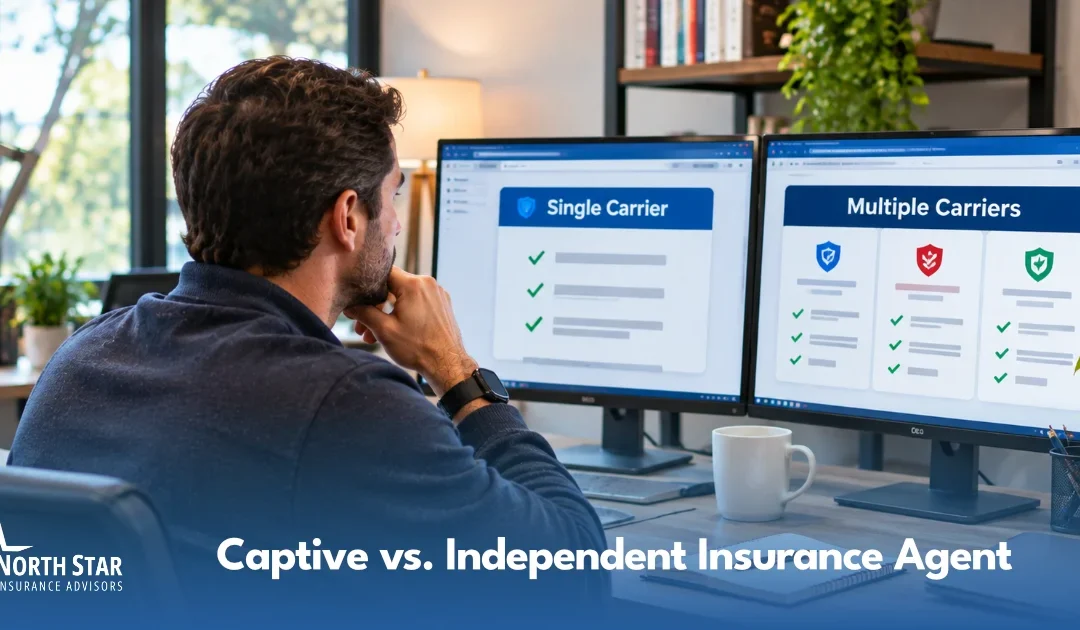
A captive insurance agent sells products from one insurance company. An independent insurance agent is appointed with several carriers and can compare options for each client. Captive roles usually offer more structure, training, and brand support. Independent roles offer more product choice, more control, and, in many cases, more ownership of your book of business. Which one fits you depends on how much support you want and how much independence you’re ready for.
Written by the North Star Insurance Advisors recruiting team. New and experienced agents often ask us which setup fits their goals, and the honest answer is that it depends on the person.
Captive vs independent at a glance
The core difference is how many insurance companies you represent. Everything else (products, pay, support, ownership) follows from that.
| Captive agent | Independent agent | |
| Carriers represented | One | Several, through separate appointments |
| Products you can offer | That company’s products only | Options from multiple carriers |
| Training and onboarding | Usually structured, company-run | Varies; often provided by an agency, IMO, or FMO |
| Leads and marketing | Often supported by the company brand | Varies widely; sometimes self-funded |
| Pay structure | Varies: salary plus commission, or commission only | Usually commission only |
| Who owns the book of business | Often the carrier | Often the agent or agency, depending on the contract |
| Best fit | New agents who want structure | Agents who want choice and control |
| Common examples | State Farm and Allstate (P&C); career agencies at large life insurers | Independent agencies, brokers, IMO/FMO-affiliated agents |
What is a captive insurance agent?
A captive insurance agent is contracted to sell for a single insurance company. If a client doesn’t qualify or the price isn’t right, a captive agent can’t shop another carrier.
The tradeoff is support. Captive agents typically get company training, branded marketing, and established systems. That makes captive roles a common starting point for new agents. The limits come later: you can only offer what that one company sells, and in many captive contracts the carrier, not you, owns the client relationships if you leave.
What is an independent insurance agent?
An independent insurance agent holds appointments with multiple carriers and can match each client to the company that fits best. Independent agents don’t work for one insurer, though they still represent insurers rather than the client. That’s what separates an agent from a broker, which our guide to insurance broker vs agent explains.
Independent agents are a large part of the market. The Independent Insurance Agents & Brokers of America reported that independent agencies wrote 61.5% of all U.S. property and casualty premiums in 2024, including 87.2% of commercial lines and 39% of personal lines (Big “I” 2025 Market Share Report).
The tradeoff is responsibility. Independent agents often handle more of their own marketing, contracting, and tools, unless they work through an agency that provides them.
Captive vs independent is not the same as W-2 vs 1099
This is the most common mix-up in insurance careers. Captive vs independent describes how many carriers you represent. W-2 vs 1099 describes how you’re employed and taxed. The two don’t always line up.
- A captive agent can be a 1099 contractor. Many captive agents run their own agency as independent contractors while selling for only one company.
- An independent agent can be a W-2 employee. Some independent agencies hire salaried agents who sell across many carriers.
- “Independent contractor” in a job post refers to your tax status, not your carrier access.
Before you accept any role, ask both questions separately: how many carriers can I offer, and am I W-2 or 1099? Our breakdown of W-2 vs 1099 commission sales jobs covers the tax side in detail.
Pros and cons of each path
Each path solves a different problem. Captive solves “I don’t know where to start.” Independent solves “I want more options for my clients.”
Captive agent pros
- Structured training and a clear playbook
- Brand recognition that helps clients trust you
- Company marketing and, in some roles, salary or benefits
Captive agent cons
- One carrier’s products and prices only
- Less control over commission rates
- Clients often stay with the carrier if you leave
Independent agent pros
- More carriers means more clients you can place
- More control over your schedule, niche, and business
- Better potential to own your book of business
Independent agent cons
- Less built-in structure, especially early on
- You may pay for your own leads, tools, and marketing
- Income is usually commission only and less predictable
Why carrier choice matters in final expense
In final expense insurance, access to more than one carrier directly affects how many clients you can help. Final expense clients are often older adults with health conditions, and each carrier underwrites those conditions differently. A client declined by one company may qualify for immediate coverage with another.
With a single carrier, a health answer can end the conversation. With several, it often just changes which application you fill out. That’s why many final expense agents work through agencies that handle contracting with multiple carriers for them.
Which path fits you?
Choose captive if you’re new and want structure. Choose independent if you want choice and control and can manage more of your own business. Many agents start captive and move independent later. Others go straight to an independent agency that provides the training a captive company would.
Captive tends to fit if you:
- Are brand new and want a set system to follow
- Value brand recognition and company marketing
- Prefer stability over flexibility
Independent tends to fit if you:
- Want to offer clients more than one option
- Are comfortable working on commission
- Want to build a book of business you control
A middle path: an independent-style role inside an agency that supplies leads, training, and carrier contracting gives you multi-carrier access with less of the do-it-yourself burden.
Questions to ask before you choose
Ask any recruiter these four questions, whatever the role is called:
- How many carriers will I be appointed with?
- Am I a W-2 employee or a 1099 contractor?
- Who owns my clients and renewals if I leave?
- Who provides leads, training, and contracting, and what do they cost me?
The answers tell you more about the job than the words “captive” or “independent” in the posting.
Frequently asked questions
A captive agent sells products from one insurance company only. An independent agent is appointed with multiple carriers and can compare their products for each client. Captive roles usually offer more structure and brand support, while independent roles offer more product choice and control over your business.
Neither is better for everyone. Captive roles suit new agents who want training, brand support, and a set system. Independent roles suit agents who want more carrier options, more control, and ownership of their book. Many agents start captive and move independent as they gain experience.
Not always. Captive agents may earn salary plus commission or receive benefits, while independent agents usually earn commission only but often at higher rates. Total income depends more on lead flow, production, and contract terms than on the captive or independent label.
Yes. Captive vs independent describes how many carriers you represent, not your tax status. Many captive agents work as 1099 independent contractors while selling for one company, and some independent agencies employ W-2 agents. Always ask about both separately.
In many captive contracts, the carrier owns the client relationships, so your book stays with the company if you leave. Independent agents more often own or share ownership of their book, depending on their agency contract. Check the contract’s ownership and vesting terms before signing.
Not sure which path fits?
North Star hires licensed agents as 1099 independent contractors to take inbound final expense calls from home. Leads are provided, carrier contracting is handled for you, and a Business Advisor team supports your onboarding. Ask us how carrier appointments and book ownership work on your interview call. Apply for a remote sales agent role.