
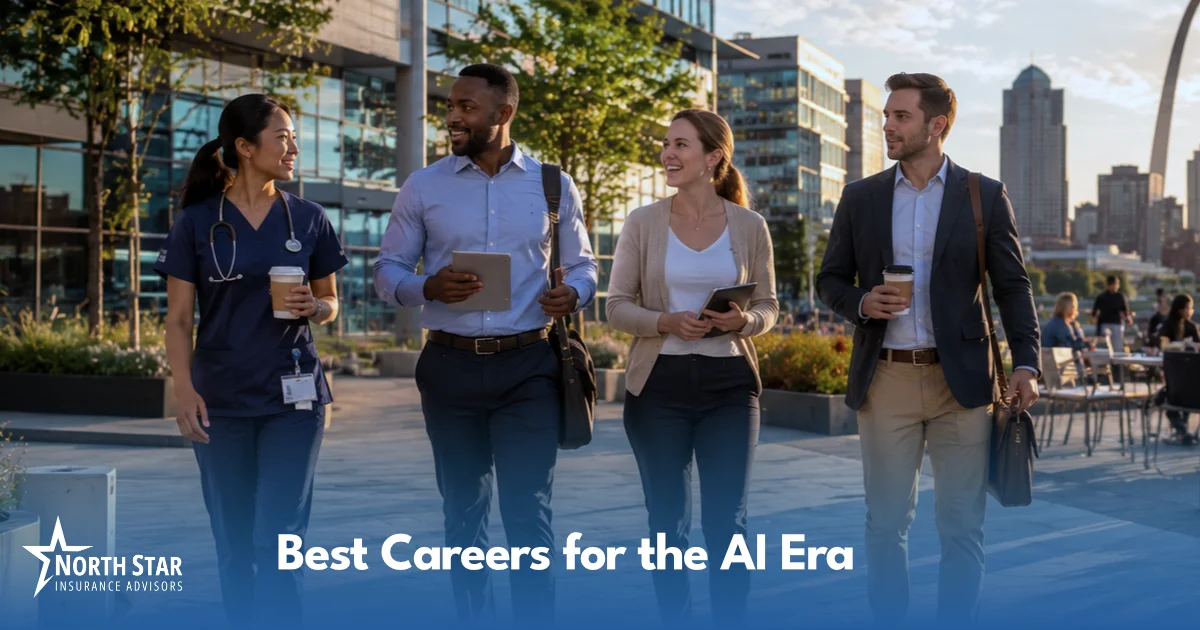
Artificial intelligence is reshaping nearly every industry, but the strongest career opportunities often combine technology with uniquely human skills. In our pillar guide, Will AI Replace Life Insurance Agents? Why Remote Insurance Careers Are Booming in 2026, we examine why relationship-driven professions continue to thrive as AI adoption accelerates.
Artificial intelligence is changing the way people work. Tasks that once required hours of manual effort can now be completed in minutes through automation, machine learning, and advanced software tools. As businesses continue adopting AI technologies, many professionals are asking an important question: what careers will remain valuable in the future?
The answer is not necessarily careers that avoid technology. Instead, the strongest opportunities often belong to professionals who can work alongside technology while providing skills that AI cannot easily replicate.
According to LinkedIn’s Jobs on the Rise 2025, many of the fastest-growing roles combine technical knowledge with communication, leadership, problem-solving, and relationship-building abilities. As the workplace evolves, careers that blend human expertise with modern technology are becoming increasingly attractive.
The AI era is not simply creating new jobs. It is redefining which skills matter most.
Technology Is Transforming Every Industry
Artificial intelligence is no longer limited to technology companies. Today, AI tools are being used across healthcare, education, finance, manufacturing, insurance, and countless other sectors.
Businesses use AI to:
- Analyze data faster
- Automate repetitive tasks
- Improve customer service
- Increase productivity
- Support decision-making
The Stanford University AI Index Report 2026 highlights the rapid growth of AI adoption across industries while also showing that organizations continue investing heavily in human talent.
Rather than replacing every worker, AI is changing how work gets done.
The Best Careers Combine Technology and Human Skills
One of the biggest misconceptions about AI is that technical skills alone will determine future career success.
While technology skills remain important, employers are increasingly seeking professionals who can combine technical capabilities with human-centred strengths.
These include:
- Communication
- Leadership
- Adaptability
- Critical thinking
- Emotional intelligence
- Collaboration
LinkedIn’s Skills on the Rise 2025 report identifies many of these capabilities among the fastest-growing professional skills.
As automation handles routine work, human interaction becomes even more valuable.
Healthcare Professionals
Healthcare remains one of the strongest career sectors in the AI era.
Doctors, nurses, therapists, and healthcare specialists increasingly use technology to improve patient outcomes, but the profession continues to rely heavily on empathy, communication, and trust.
Patients often need reassurance, education, and personalized support during important health decisions.
Technology can support healthcare professionals, but it cannot replace human care.
Teachers and Educators
Education continues evolving through digital learning tools and AI-powered resources.
However, teaching involves far more than delivering information.
Great educators:
- Inspire students
- Adapt lessons
- Encourage growth
- Build confidence
- Provide mentorship
These human interactions remain essential regardless of technological advancement.
Financial Advisors
Financial planning requires more than numbers.
Clients often seek guidance regarding retirement, investments, risk management, and long-term financial goals.
While AI can analyze data and generate recommendations, people frequently want reassurance and personalized advice when making major financial decisions.
Trust remains one of the profession’s greatest assets.
Insurance Professionals
Insurance continues to stand out as one of the most resilient professions in the AI era.
Modern insurance professionals use digital tools, automation, and virtual communication platforms to improve efficiency. However, their primary value comes from helping clients make informed decisions about financial protection.
According to LIMRA’s 2025 Insurance Barometer Study, many consumers continue to recognize the importance of life insurance while remaining uncertain about their coverage needs.
This creates opportunities for professionals who can provide education, guidance, and personalized recommendations.
Whether someone is exploring an Insurance Agent Careers Guide, researching What Do Insurance Agents Do, or considering Life Insurance Jobs Remote, the industry offers a unique blend of technology and human interaction.
Technology Specialists With Strong Communication Skills
Technical expertise remains highly valuable, particularly when combined with communication abilities.
Professionals such as:
- Cybersecurity specialists
- AI implementation consultants
- Data analysts
- Cloud architects
- Technology trainers
often serve as a bridge between technical systems and business users.
The ability to explain complex information clearly is becoming increasingly important.
Leadership Roles
Leadership is one area where human skills remain difficult to automate.
Managers and executives must:
- Motivate teams
- Resolve conflicts
- Make strategic decisions
- Develop talent
- Build organizational culture
While AI can provide insights and recommendations, leadership continues to depend on human judgement.
Why Human-Centred Careers Remain Strong
Microsoft’s 2025 Work Trend Index Annual Report suggests that organizations are increasingly looking for professionals who can use AI effectively while maintaining strong communication and collaboration skills.
This trend supports careers that combine technology with relationship-building.
The most successful professionals will likely be those who learn how to work with AI rather than compete against it.
Future Careers Will Reward Adaptability
The OECD’s Employment Outlook 2025 highlights how workforce requirements continue evolving as technology advances.
Adaptability has become one of the most important professional traits.
Workers who continuously learn, embrace change, and develop new skills are more likely to thrive regardless of industry.
Future-proof careers are not necessarily tied to specific job titles. They are often built around transferable skills that remain valuable across multiple industries.
Why Insurance Is Uniquely Positioned
Insurance represents an excellent example of a profession that combines technology and human expertise.
Modern agents use:
- AI-powered tools
- Digital applications
- Virtual consultations
- CRM systems
- Automated workflows
At the same time, success continues to depend on:
- Trust
- Communication
- Relationship-building
- Problem-solving
- Personal guidance
This combination makes insurance particularly well-positioned for long-term growth in the AI era.
Final Thoughts
The best careers for the AI era are not those that avoid technology. They are the careers that use technology to enhance human strengths.
The World Economic Forum’s Future of Jobs Report 2025 identifies communication, leadership, resilience, adaptability, and social influence among the fastest-growing workplace skills. These abilities remain difficult to automate because they rely on uniquely human qualities.
As artificial intelligence continues advancing, professionals who combine technology with empathy, communication, and relationship-building may find themselves among the most valuable members of the future workforce.
Related Articles to Read
Insurance Agent Careers Guide
Learn how insurance professionals build successful long-term careers while helping families make important financial decisions.
Life Insurance Jobs Remote
Discover how remote insurance careers combine technology, flexibility, and relationship-building.
What Do Insurance Agents Do?
Explore the daily responsibilities of modern insurance professionals and why the profession continues to thrive.
Frequently Asked Questions
Careers that combine technology with communication, leadership, critical thinking, and relationship-building are among the strongest opportunities for the future.
AI is expected to transform many jobs rather than eliminate all of them. Many professions will continue relying on human judgement and interpersonal skills.
Communication, adaptability, emotional intelligence, leadership, problem-solving, and critical thinking remain highly valuable.
Insurance continues to benefit from strong demand because clients often seek personalised guidance when making financial protection decisions.
Yes. Many insurance professionals now use virtual consultations, digital applications, and online communication tools to serve clients remotely.
Insurance, healthcare, financial advising, education, consulting, and leadership roles all combine technology with human expertise.
As technology automates routine tasks, human-centred skills such as trust, empathy, and communication become increasingly valuable.
Not necessarily. Many successful professionals use technology tools while focusing on communication, leadership, and relationship-building.
Insurance, healthcare, education, financial services, and consulting are expected to continue benefiting from strong human involvement.
Insurance, healthcare, education, financial services, and consulting are expected to continue benefiting from strong human involvement.
Looking for a Career That Thrives Alongside Technology?
The best careers for the AI era aren’t necessarily the most technical. They’re often the professions that combine modern technology with trust, communication, and human connection.
Insurance continues to offer opportunities for professionals who want flexibility, growth potential, and meaningful work while using technology to better serve clients.
Explore career opportunities with North Star Insurance Advisors today.